NexusWeb Products
Status: In DevelopmentIn active developmentContextPulse AI
AI-assisted context recovery for developers — built to support people, not to watch them.
An AI-powered, privacy-first developer workflow and context-recovery solution.
ContextPulse AI is a privacy-first developer workflow and context-recovery tool. When you come back from a meeting or a break, it reminds you where you left off. When a team keeps getting stuck, it helps leads see the pattern — without turning anyone into a surveillance target.
Development status
ContextPulse AI is in active development. It is a working prototype, not a commercially released or production-ready product. We are not publishing performance or time-saving figures until we have measured them properly.
Live demo
Try ContextPulse AI
Experience ContextPulse AI through an interactive developer and manager workflow simulation. Explore how development interruptions, context recovery, and team-level insights are represented in the current prototype.
Interactive prototype — currently in active development. Demo functionality may change.
Opens the ContextPulse AI application in a new tab. Demo sign-in details are shown on the application's own login screen.
Developer experience
Sign in to the developer panel, simulate a break, and get a short reminder of your last working context — written by AI, or by a safe template when the AI service is unavailable. Then note anonymously why you were interrupted.
Manager experience
Sign in to the manager panel to see team-level blocker categories — shown only once enough people report them — track actions on them and post team-wide announcements.
The problem
Interruptions are expensive — and the usual fixes make things worse.
Lost context
After a meeting, a break or a task switch, developers spend time reconstructing what they were doing: which function, which error, which review comment.
Invisible blockers
Team leads often can't see why work stalls — slow reviews, flaky CI, unclear requirements — until it is already a problem.
Monitoring backfires
Screenshots, keystroke logging and per-person activity scores erode trust and raise ethical and legal concerns.
The proposed solution
Two sides of one loop.
- 1
For developers
A reminder, not a report
When you return, an AI-generated summary recovers your last working context: the function you last changed, an open error, a failing test, unresolved pull-request comments.
- 2
For team leads
Patterns, not people
Developers can anonymously note why they were interrupted. Leads see blocker categories only at team level — and only once enough people have reported the same one.
- 3
Closing the loop
Action that developers can see
Leads can track actions on visible blockers and post team-wide announcements, which appear live in every developer's panel.
You were fixing currency parsing in parseInvoice(). One test is still failing.
- Last edit
- parseInvoice()billing/parser.py
- Failing test
- test_parse_currency1 failure
- Open review
- 2 unresolved commentson your pull request
What works today
Capabilities in the current prototype
These features exist in the public repository today. They run as a working prototype with demo data — not as a released product.
Metadata-only ingestion
The API rejects events that flag screen capture, keystroke content or source code, as well as any field outside the schema (such as source_code).
Validated AI reminders
Reminders are written by Gemini or Claude, then checked by code. If the output mentions a file, function, error code or PR that isn't in the metadata, a safe fallback text is used instead.
K-anonymous team view
A blocker category becomes visible to a lead only after at least five developers report it. Below that, it is shown as hidden — with no exact count.
Action tracking
Leads can set a status, owning team and note on visible blockers. Acting on hidden groups is rejected by the server.
Team announcements
Team-wide messages appear live in developer panels via Server-Sent Events. They can't be addressed to an individual.
Bilingual interface
Azerbaijani and English, including the AI reminders themselves.
Privacy-first by design
Support developers. Don't surveil them.
Privacy isn't a feature added at the end — it shapes what the system is allowed to collect in the first place.
- No screenshots and no screen recording.
- No keystroke content.
- No reading of private source code.
- No individual identifiers in the lead's view.
- Small groups stay hidden, so individuals can't be singled out.
- Only validated metadata is sent to the AI model.
Honest limitations
What the current prototype does not do yet:
- There is no IDE extension yet — IDE events are currently generated by a simulator script.
- Storage uses SQLite for the demo; a production database is planned.
- K-anonymity does not fully protect against observation over time.
- Demo accounts and passwords are for local testing only.
National context
In step with Azerbaijan's digital and AI priorities.
ContextPulse AI is an AI tool for software teams, built in Azerbaijan. Its aims, responsible and privacy-first use of AI and more productive digital work, match the direction set by these national policy documents.
19 March 2025
Presidential Order No. 530
On approving the Artificial Intelligence Strategy of the Republic of Azerbaijan for 2025–2028
Official text (opens in a new tab)11 October 2021
Presidential Decree No. 1464
On certain measures to improve governance in digitalisation, innovation, high technologies and communications in the Republic of Azerbaijan
27 February 2026
Presidential Order
On approving the Action Plan for accelerating digital development in the Republic of Azerbaijan for 2026–2028
Official text (opens in a new tab)
Listed for context only. ContextPulse AI is an independent project; listing these documents does not mean it is endorsed by any government body.
Product demonstrations
See it in action.
Screenshots and walkthrough videos of the working prototype.
Walkthrough (2:04, with music and step captions): a developer returns from a break and gets an AI reminder of where they left off, then records the reason anonymously. The team lead plans an action on a team-level blocker and sends an announcement, which the developer sees live. 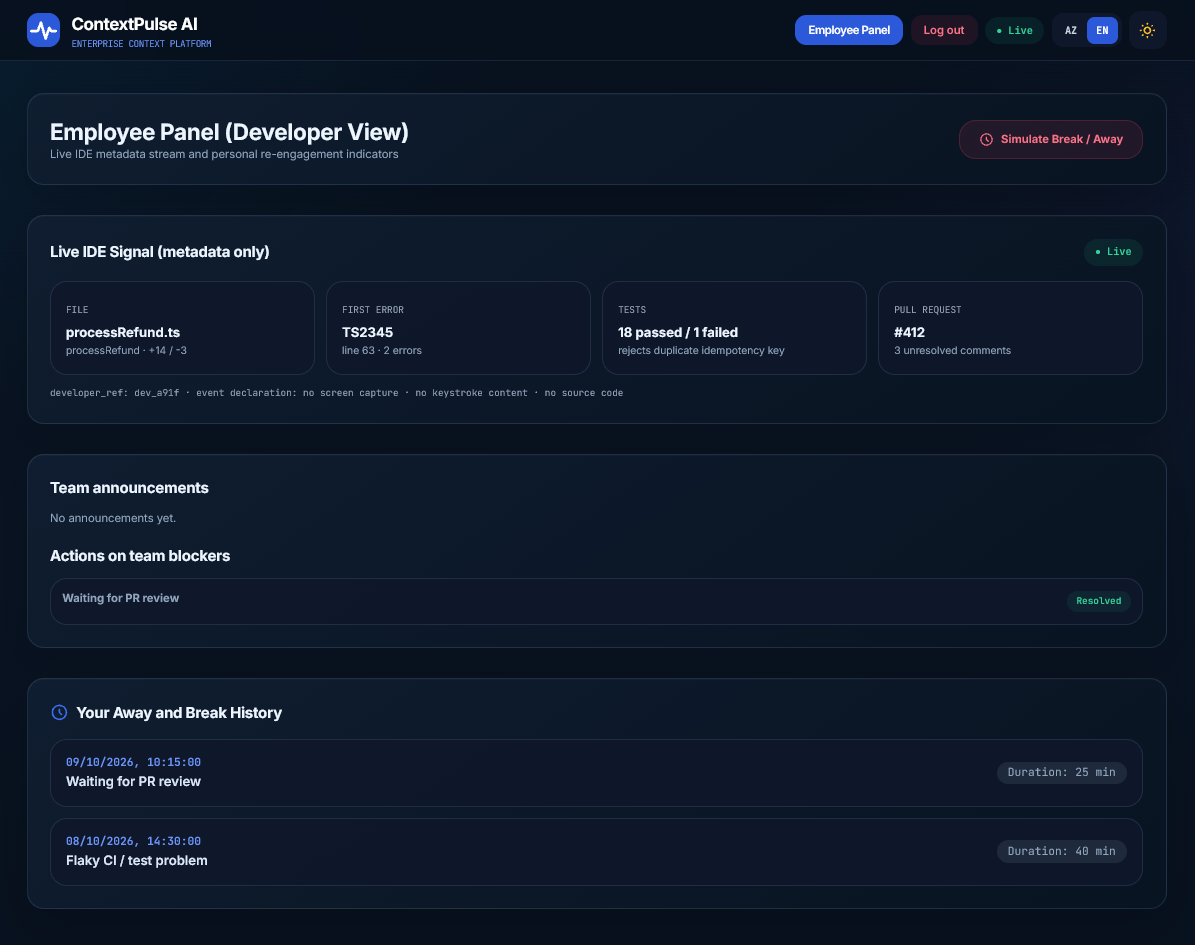
Developer panel: live IDE metadata (file, first error, tests, pull request) and personal break history. No screen capture, keystrokes or source code. 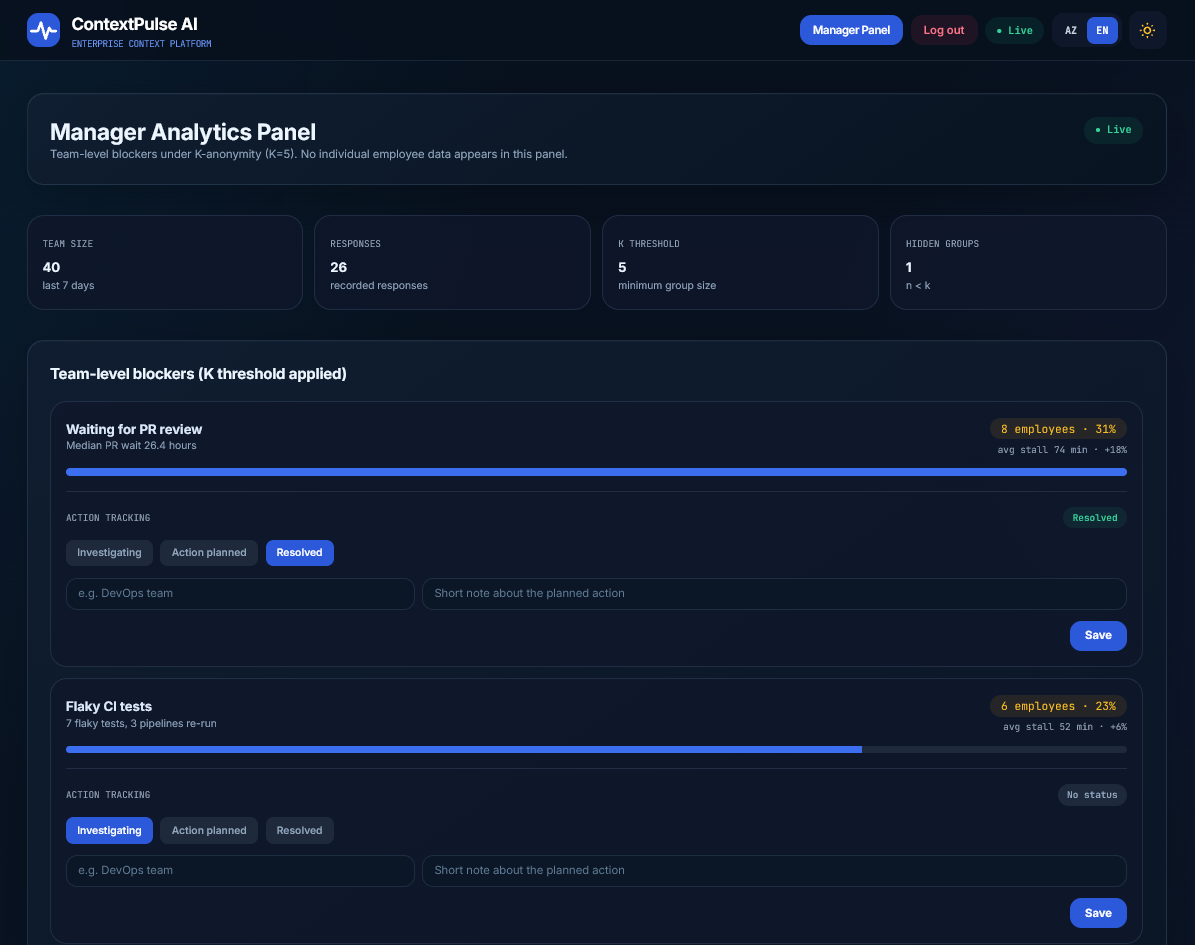
Team lead panel: team-level blockers under k-anonymity (k=5) with action tracking. No individual employee data is shown.
Development journey
How it has evolved so far.
Milestones from the public commit history.
Oct 2026
First prototype
A Streamlit prototype with mock data explores the context-recovery idea.
Oct 2026
Reliable AI reminders
Fallback AI models, timeouts, an output validator and automated tests are added.
Oct 2026
Manager panel
Action tracking on blockers and team-wide announcements close the feedback loop.
Oct 2026
Interface redesign
New routes, a role portal, legal pages and locally hosted fonts.
Nov 2026
Server-side authentication
A second redesign moves sign-in checks to the server and refreshes the test suite.
Nov 2026
Multiple AI providers
Claude models are supported alongside Gemini, with configurable provider order.
Nov 2026
Security audit fixes
Critical issues found in a security review are fixed, including keyed event ingestion.
Project team
The people behind ContextPulse AI.
The original ContextPulse AI concept was proposed by Nuran Əliyev. The project has been developed collaboratively by:
Nuran Əliyev
Proposed the original concept
Elgün Hüseynli
Mikayıl Mövsümzadə
Built with
- Python
- FastAPI
- SQLite
- Google Gemini
- Anthropic Claude
- React
- Server-Sent Events
- pytest
- Docker
Early access
Early access isn't open yet.
We'll open a beta-testing programme once the prototype is ready for real teams. Until then, the best way to follow progress is the public repository — or ask us to let you know by email.